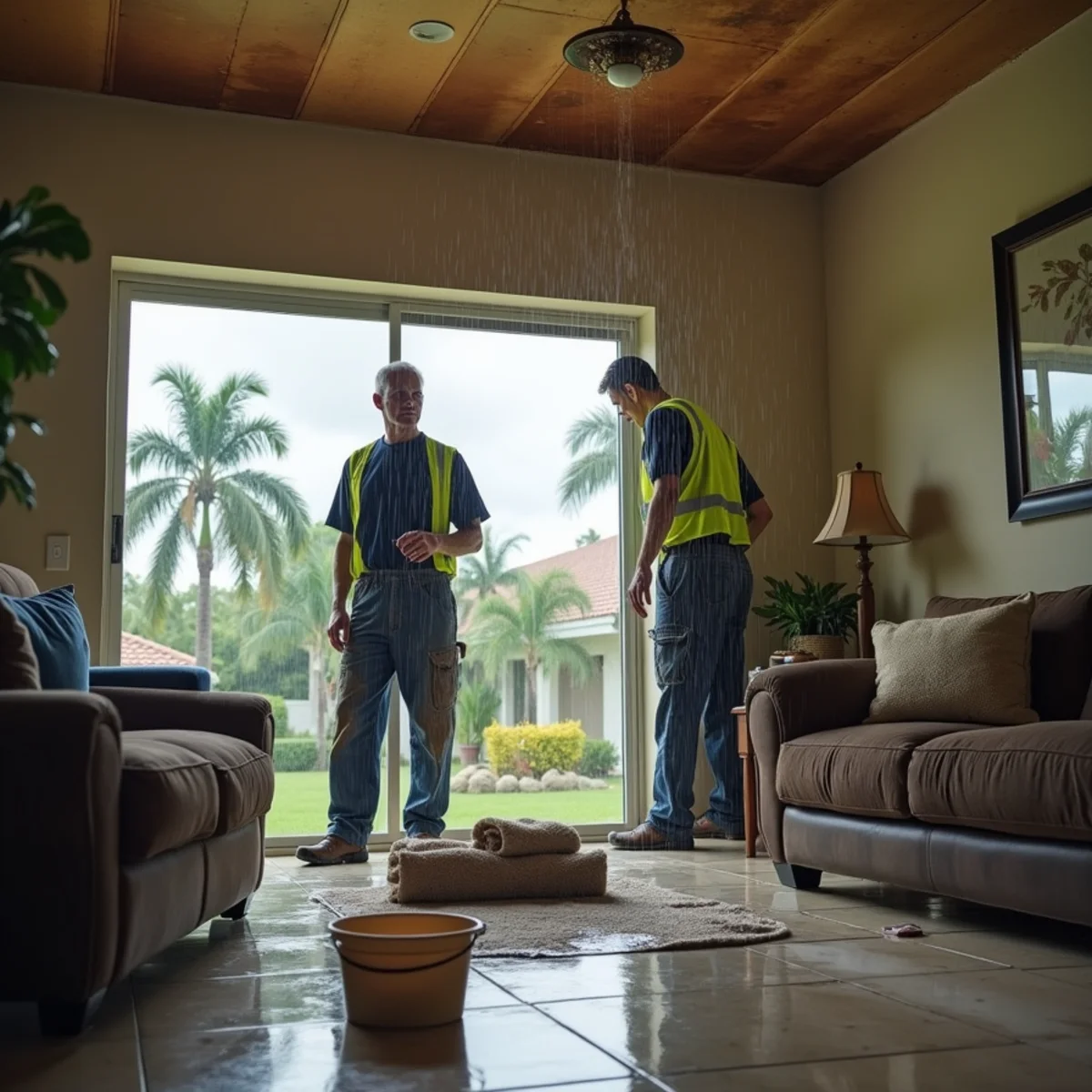
When your roof leaks during a Boca Raton storm, shut off power near the drip, catch the water, move valuables, and photograph everything while it is happening. Stay off the roof until the wind drops. Then have a roofer find the entry point from above, tarp or patch it, and scope the permanent repair in writing.
If water is coming through your ceiling while a storm is still moving over Boca Raton, your job right now is not to fix the roof. It is to keep everyone safe, limit what the water ruins inside, and collect the evidence a roofer and your insurer will need once the weather clears. The steps below follow the order that matters most in the first hour.
The first 15 minutes: safety comes before buckets
Water and electricity share the same ceiling cavity. If the drip is anywhere near a light fixture, ceiling fan, or smoke detector, switch off that circuit at the breaker panel. If the floor around the panel is wet, leave it alone and call FPL instead.
Next, look up. A ceiling that is sagging or bubbled is holding pooled water. Put a bucket under the lowest point and pierce the bulge with a screwdriver so it drains in a controlled stream. That sounds backward, but it is far better than a soaked section of drywall letting go all at once.
Finally, stay off the roof and off ladders. Wet concrete tile is slick, shingles tear under foot when saturated, and a gust during a squall can knock you off balance with no warning. Nothing on the roof is worth that risk until the storm has passed.
Contain the water inside
Once the area is safe, work outward from the leak:
- Set buckets or storage bins under every active drip, with a towel inside to stop splashing.
- Move furniture, electronics, and rugs out of the wet zone. Lift area rugs off wood floors so the finish does not cup.
- Cover anything you cannot move with plastic sheeting or trash bags.
- If you have a wet-vac, keep standing water off the floor rather than letting it spread under baseboards.
Trace the source from inside, not from above
Roof water rarely drops straight down. It runs along the deck, a rafter, or the top of a ceiling panel before it finds a way through, so the stain in your living room may start several feet away.
If your attic is accessible and you can move safely on the joists, take a flashlight up. Look for wet decking, a drip line on a rafter, or daylight around a pipe. Note where the wet spot sits relative to something you can see from outside, such as a plumbing vent, a skylight, or the wall where a lower roof meets the second story. That detail saves time later.
During wind-driven rain, the usual entry points in Boca homes are:
- Flashing where the roof meets a stucco wall, especially where the stucco stop or counterflashing has cracked
- Plumbing vent boots, where lead has split or rubber has dried out in the sun
- Skylight curbs and older curb flashing
- Tile valleys packed with leaves and seed pods that dam water sideways
- Flat roof sections whose scuppers are clogged, so water ponds until it finds a seam
- Ridge caps or ridge vents where sideways rain gets pushed uphill
Why older West Boca homes see more of these
In Boca Del Mar, many of the 1970s and 1980s condos and villas combine shingle slopes with flat sections over patios or additions. Every place those two systems meet is a transition that has to be flashed correctly, and those transitions are where storm leaks tend to show up first.
Why does the roof leak in some storms and not others?
A leak that appears in one storm and stays dry in the next is common, and it is a clue rather than a mystery. Ordinary rain falls mostly straight down and runs off the way the roof was designed to shed it. Wind-driven rain behaves differently. Gusts push water sideways and even uphill, under tile laps, over the top edge of flashing, and through ridge vents that handle normal rain without trouble.
So note which way the wind was blowing when the drip started. The slope facing that wind is where a roofer should look first. A leak that only shows up when rain comes from one direction usually points to a flashing detail, a wall transition, or a vent on that side of the house.
Signs the leak needs a call tonight, not next week
- Water is coming through more than one spot, or through a light fixture or fan
- The ceiling is sagging, cracking, or has already dropped a section
- You can see daylight or soaked decking from the attic, which often means roofing is missing
- A tree limb or flying debris hit the roof shortly before the leak began
- The drip keeps getting faster as the storm goes on
A slow drip in one place that stops when the rain stops can usually be contained and scheduled for an inspection within a few days. Do not read a dry ceiling the next morning as a sign the roof fixed itself. The opening is still there, waiting for the next squall line.
Document the leak while it is still happening
An active leak is the strongest evidence you will ever have. Take a short video of the drip with the storm visible through a window if you can. Photograph the ceiling stain, the water in the bucket, and any damaged belongings before you move them. Write down the time the leak started and when it got worse.
Keep every receipt from this point on: tarps, fans, a dehumidifier rental, hotel costs if a room becomes unusable. Most policies expect you to take reasonable steps to prevent further damage, and those records show that you did.
When the rain stops
Once winds have dropped and it is safe to be on a roof, call for emergency roof repair. A roofer should find the actual entry point from above, photograph it, and either make a temporary patch or install emergency roof tarping over the damaged area. Only after that should you get a written scope for the permanent fix.
Inside, start drying immediately. The EPA recommends drying wet building materials within 24 to 48 hours to limit mold growth, so run fans and a dehumidifier. Soaked insulation and drywall that stays soft usually has to be cut out rather than dried in place.
A tarp or a bead of roof cement is a stopgap, not a repair. In Florida sun and daily summer rain, temporary fixes break down quickly, so plan the permanent repair within weeks, not months.
Notify your insurance company promptly if you think the storm caused the damage. Your roofer can document the condition of the roof, but the coverage decision belongs to the insurer.
Mistakes that make storm leaks worse
- Climbing up during the storm to "just throw a tarp on"
- Smearing roof cement over wet tile, which rarely seals and makes a proper repair messier later
- Throwing out wet belongings before photographing them
- Letting a stranger who knocks after the storm start work without a written contract, a permit where required, and a license you have checked at myfloridalicense.com
- Accepting any offer to waive or cover your deductible, which is illegal in Florida
What we find when we trace storm leaks in Boca homes
The stain is almost never directly under the hole. On a tile roof, water that slips past a cracked or displaced tile runs down the underlayment until it reaches a tear, a nail penetration, or a lap that has lost its seal, and that point can sit several feet downslope from the broken tile you can see. On a shingle roof, water often rides the top of a rafter before it drips. We measure from a fixed reference, such as a plumbing vent or an exterior wall, both inside and outside, so the search on the roof starts in the right place.
A dry day does not end the investigation. When looking alone cannot pin a leak down, the next step is a controlled water test. One small zone gets soaked with a hose at a time, starting at the lowest point and working upward, while someone watches the ceiling or attic inside. It is slow, and it cannot fully recreate wind-driven rain, but it separates a flashing leak from a vent boot or a valley far more reliably than guessing.
Some storm-season leaks are not the roof at all. In homes with the air handler or ductwork in the attic, a clogged condensate line or rusted drain pan can drip onto the ceiling during the same humid weeks that bring the storms. Window heads, stucco cracks, and wall penetrations for dryer vents or exterior lights can also let sideways rain into a wall. An attic check before anyone opens the roof keeps you from paying for a repair in the wrong place.
The quick fix applied in the dark is where many repeat leaks begin. Roof cement smeared onto a wet tile or a split lead boot may hold for a week, but it hides the real failure and has to be scraped off before the proper repair can start. We would rather leave a clean, well-anchored tarp over the area and an honest note of what is still unconfirmed than a patch that makes the next inspection harder.
Get the leak traced and fixed the right way
A storm leak almost always has a specific cause: a lifted tile, a cracked boot, failed flashing, or a clogged scupper. Finding it from the roof side, rather than guessing from the ceiling stain, is what keeps the same spot from leaking again next rainy season.
If the storm also tore roofing loose and you are waiting on a crew, our hurricane tarping checklist shows what a proper temporary cover should look like, so you can judge the work when it arrives.
If your roof leaked during the last storm, call Rising Roof Services at (831) 666-1600 or request an inspection. We will trace the entry point, document what we find with photos, and give you a clear scope for roof leak repair in plain language.
Frequently asked questions
Can a roofer fix my leak while the storm is still going?
Usually not safely. Roofers generally wait until lightning has passed and winds have dropped before going on a roof, because wet tile and shingles are slippery and gusts are unpredictable. During the storm, focus on containing water inside and documenting it. Once conditions allow, a crew can tarp or patch the area and then scope the permanent repair.
Will homeowners insurance cover a roof leak that started in a storm?
It depends on your policy and on the cause. Insurers typically look at whether wind or a falling object created an opening in the roof versus long-term wear. Photos, dates, and a roofer's written findings help the insurer make that call. A contractor can document damage, but cannot promise that a claim will be approved.
How can I tell if the water is coming from the roof or a window?
Look at where the stain appears. Water at the top of a wall or in the middle of a ceiling usually points to the roof, while staining below a window head or along the sill often means window or stucco leaks from wind-driven rain. An attic check or a professional inspection can confirm which one you are dealing with.
Why did my roof stop leaking as soon as the rain stopped?
Because the opening only takes on water while rain is hitting that part of the roof, often from one particular wind direction. The damaged flashing, boot, or tile is still there, and wet decking or insulation may still be drying above the ceiling. A leak that stops on its own is a warning, not a repair, so have the roof inspected before the next storm arrives.
Could the drip be coming from my air conditioner instead of the roof?
Yes, particularly if it shows up in humid weather without heavy rain, or near an attic air handler or supply register. A clogged condensate drain or an overflowing drain pan can stain a ceiling just like a roof leak. If the drip continues on dry days and sits close to the air handler, call an HVAC technician first and a roofer second.